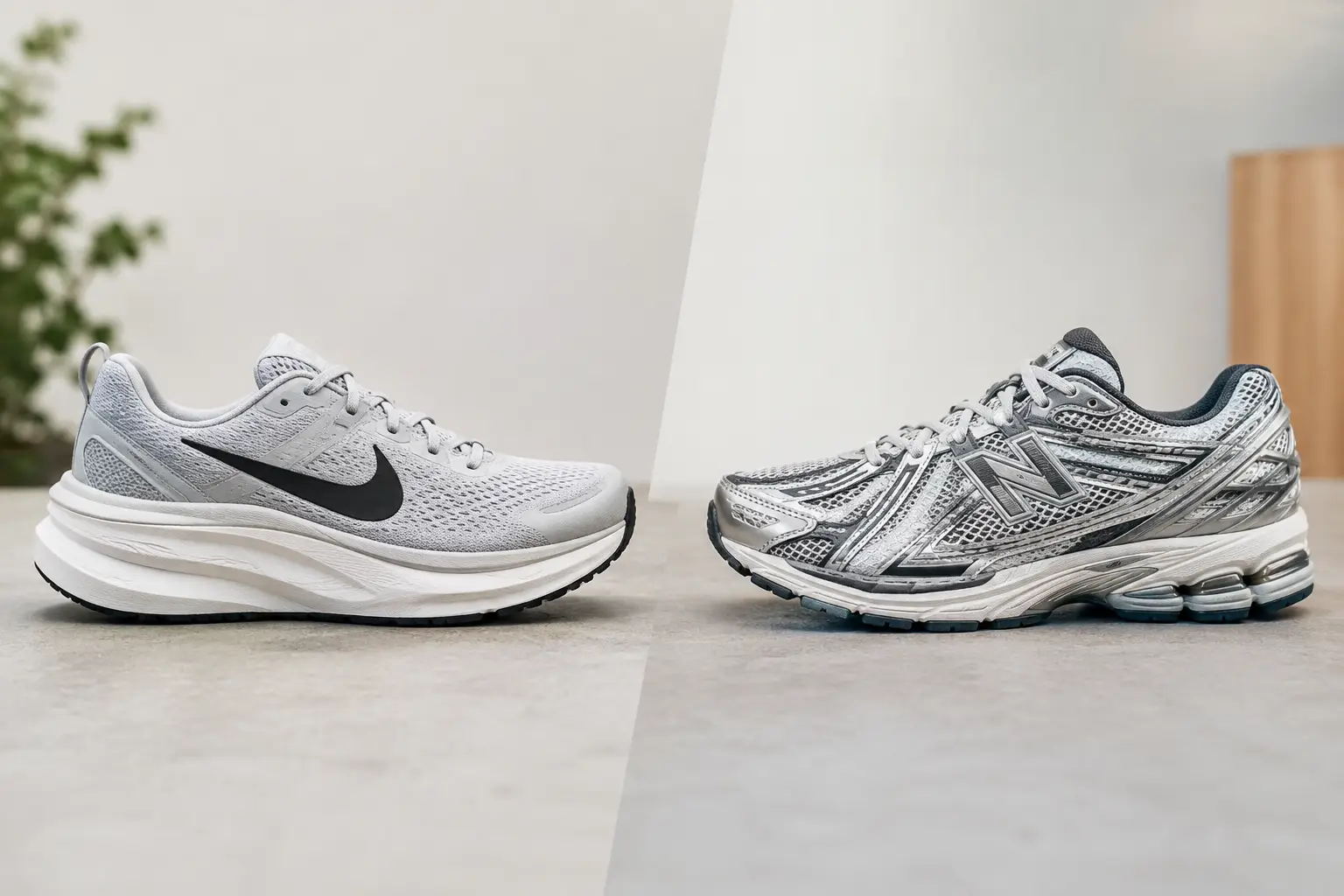
The Nike Vomero vs 1906R decision is less about finding a winner and more about choosing your version of the retro-runner look. Both models sit comfortably in the Y2K running-shoe revival, with layered mesh, technical overlays, and the kind of shape that works under loose denim or tailored cargos. But on foot, and in a rotation, they offer very different energy.
The Nike Zoom Vomero 5 feels smoother, softer, and more sport-informed. The New Balance 1906R is denser, more structured, and has become a go-to for people building outfits around silver panels, aged neutrals, and performance details. If you want one pair to wear hard, style often, and still feel current after the trend cycle shifts, the distinction matters.
Nike Vomero vs 1906R: The quick read
Choose the Nike Zoom Vomero 5 if comfort is your first filter. Its layered upper and rounded sole give it a lighter, more cushioned feel that suits long days, travel, and casual daily wear. It also has a slightly cleaner visual flow, especially in neutral colorways such as Photon Dust, Sail, or soft gray.
Choose the New Balance 1906R if you want a more technical, fashion-forward runner. Its segmented sole unit, heel cage, and sharper paneling bring more visual texture to an outfit. The model also has a deeper catalog of collaborations and variants, from protection-focused takes to releases that lean into trail and outdoor references.
Neither is a performance running shoe you should buy strictly for modern training. They borrow real running DNA, but their place now is on the street. The better choice comes down to whether you prioritize underfoot comfort or a more expressive silhouette.
Design language: soft runner versus technical runner
The Vomero 5 comes from Nike's mid-2000s running archive, and it wears that history lightly. Mesh dominates the upper, while the plastic side cage creates structure without making the shoe look bulky. Curved lines around the heel and midfoot give it a fluid shape. Even when Nike uses bright accents, the shoe tends to look airy rather than aggressive.
That makes the Vomero easy to integrate into a wardrobe. It can soften a heavyweight streetwear fit, work with athletic shorts without looking like a gym shoe, or add a relaxed contrast to smarter pants. It has enough detail to look intentional, but it rarely becomes the loudest piece in the outfit.
The 1906R is more mechanical. Its open mesh base, synthetic overlays, TPU heel counter, and segmented outsole create a busier profile from every angle. New Balance has leaned into this construction through colorways that mix metallic silver, cream, black, navy, and muted green. The result feels closer to the tech-runner wave that shaped much of recent sneaker fashion.
That visual density is a strength if you dress with layers. The 1906R looks especially good with washed black jeans, nylon pants, fleece, vintage sportswear, and technical outerwear. With minimalist outfits, though, it can dominate more than the Vomero. That is not a flaw, just a styling trade-off.
The colorway factor
Colorway can flip the usual recommendation. A clean white-and-silver Vomero 5 can look more futuristic than an earthy 1906R, while a dark 1906R can become the more practical everyday pair. Start with the silhouette, then consider how the specific colorway connects to the clothes you already wear.
For collectors, the 1906R arguably offers more room to chase product stories. The line has been a frequent canvas for high-profile collaborators and experimental constructions. The Vomero 5 has also had standout moments, but Nike tends to make its biggest impact through highly wearable general releases and clean seasonal palettes.
Cushioning and everyday comfort
The Vomero 5 has the advantage for most people who spend a lot of time on their feet. Its Cushlon foam and Zoom Air cushioning create a softer, more forgiving ride than the 1906R. It is not marshmallow-soft, and that is a good thing. The foam still feels controlled enough for all-day city wear, while the mesh upper keeps the shoe relatively breathable.
The 1906R uses a combination of ACTEVA LITE foam, ABZORB SBS cushioning in the heel, and N-ergy technology in the outsole. It feels supportive and stable, particularly through the rear foot, but firmer and more structured overall. Some wearers prefer that planted sensation. If soft shoes make your feet feel tired or unstable, the 1906R may actually be the better long-day option.
Think of the difference this way: the Vomero 5 feels like a comfortable runner adapted for style, while the 1906R feels like a technical sneaker that happens to be very wearable. For airport days, walking-heavy weekends, or a one-sneaker travel plan, the Nike gets a narrow edge. For everyday commuting and sharper streetwear looks, the New Balance holds its own.
Fit and sizing: where most buyers should be careful
Both models generally work true to size, but feet are individual and these are not identical fits. The Vomero 5 has a secure midfoot and a fairly standard forefoot. It can feel slightly snug at first because of the layered construction and cage, especially if you have a wider foot. Most people should start with their usual Nike size. Wide-footed wearers who sit between sizes may prefer going up half a size for extra toe-room.
The 1906R also usually fits true to size, but its shape is more structured around the heel and midfoot. It does not have the broad, relaxed feel of New Balance's classic Made in USA silhouettes. If you know you are wide-footed, trying your normal size first is sensible, but a half-size up can make more sense if you dislike a close forefoot fit.
Socks change the equation. The Vomero works well with standard athletic socks and still has enough volume for a thicker pair. The 1906R's more locked-in construction feels best with midweight socks. Avoid sizing up simply for the oversized look. These shoes already have enough visual presence, and a sloppy fit takes away from their shape.
Which one has more cultural weight?
The 1906R has become one of New Balance's most visible modern lifestyle models. It arrived at the right moment, when the market was hungry for archive runners that felt less obvious than the usual options. Its collaborations and Protection Pack-adjacent design language helped cement it as a sneaker with fashion credibility, not just nostalgia appeal.
The Vomero 5 belongs to Nike's broader return to mesh runners, but it plays a different role. It is the sneaker people reach for when they want the retro-runner formula without the harder edge of a trail-influenced or heavily layered shoe. It has been embraced by stylists, sneaker fans, and everyday wearers because it is easy to wear repeatedly without feeling played out.
From a value perspective, neither model should be treated as a guaranteed resale play. Demand is colorway-specific, collaboration-specific, and subject to fast-moving trend cycles. Buy limited pairs because the story, materials, or design genuinely speak to you. Buy general releases because you can see them earning regular wear.
Styling the Vomero 5 and 1906R
The Vomero 5 shines when the outfit has movement. Try it with relaxed straight-leg denim, a washed hoodie, and a simple cap, or pair it with lightweight nylon shorts and a vintage sports tee. Its rounded, breathable build also complements loose trousers without adding too much weight below the ankle.
The 1906R works best when you let its technical detailing echo elsewhere. Think ripstop pants, a textured knit, an oversized fleece, or a structured jacket. It can also elevate a simple uniform of gray sweats and a heavyweight tee, because the shoe supplies the metallic texture and shape the outfit needs.
There is no rule against swapping those formulas. A 1906R with clean blue jeans can look great precisely because it creates contrast, and a Vomero under cargo pants can still feel technical. The useful question is whether you want the sneaker to blend into the fit or give it a focal point.
The pair worth buying
Buy the Nike Zoom Vomero 5 if you want the more comfortable, lighter-wearing choice with easy styling range. Buy the New Balance 1906R if you want a firmer, more structured shoe with stronger technical character and a richer collaboration history.
The best retro runner is the one that fits your actual rotation, not the one collecting the most saves on your feed. Pick the pair you can picture wearing on an ordinary Tuesday, then make it yours with the right colorway.